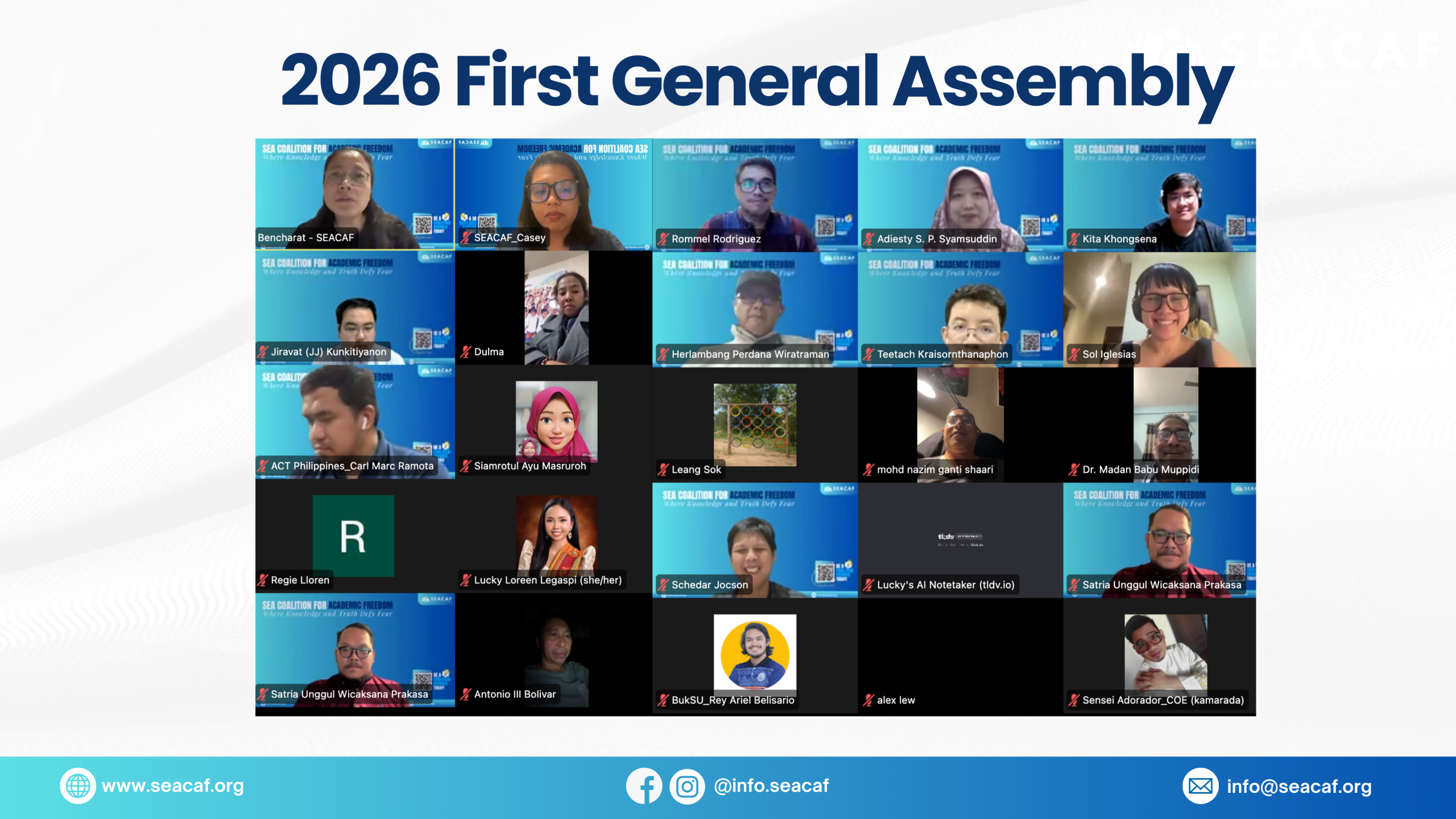
xx As approved and endorsed by the General Assembly | January 24, 2026 xx
As we enter 2026, the General Assembly of the Southeast Asia Coalition for Academic Freedom (SEACAF) reaffirms its collective commitment to defending academic freedom, institutional autonomy, and the rights of students, educators, and researchers across the region. These principles are essential to democratic societies and must be protected against escalating repression, criminalization, and political interference.
Across countries in the region, academic communities face growing threats to academic freedom and targeted attacks. In the Philippines, counter-terrorism laws and intimidation tactics have been used against student leaders following anti-corruption protests, alongside persistent red-tagging, surveillance, harassment, and book banning targeting progressive educators.. In the Philippines, counter-terrorism laws and intimidation tactics have been used against student leaders following anti-corruption protests, alongside persistent red-tagging, surveillance, harassment, and book banning targeting progressive educators. These practices reveal a systematic effort to suppress critical scholarship and political dissent within educational institutions. Among the approximately 100 individuals charged were several student leaders, who received subpoenas in October 2025, marking the second time they were summoned in connection with the same incident to submit counter-affidavits.
Similar patterns are evident in Indonesia, where harassment, threats, and intimidation have targeted peaceful protesters since August 2025, including the use of police and military force within university premises. The deployment of tear gas, weapons, and violence on campuses constitutes a serious violation of academic freedom and institutional autonomy. Universities must remain spaces free from state violence and intimidation. In Thailand, academic freedom continues to face severe restrictions through the use of lèse-majesté and national security laws to criminalize scholars and students, accompanied by the prosecution of academic Paul Chambers, whose work has been subjected to legal harassment, setting a dangerous precedent for critical scholarship.
In Myanmar, academic freedom has been systematically dismantled under military rule through direct control, surveillance, and ideological indoctrination. Universities and schools operate under loyalty-based curricula that erode institutional autonomy and suppress critical inquiry. Ongoing armed conflict has further transformed educational spaces into sites of insecurity, marked by bombings, military occupation of schools. Students and educators face severe risks for resisting indoctrination, participating in the Civil Disobedience Movement (CDM), or sustaining independent and alternative learning initiatives. Elsewhere across Southeast Asia, students, educators, and academic institutions operate under constant threat of surveillance, intimidation, and legal sanction, severely undermining the right to education. These conditions restrict free inquiry, critical thinking, and meaningful civic participation.
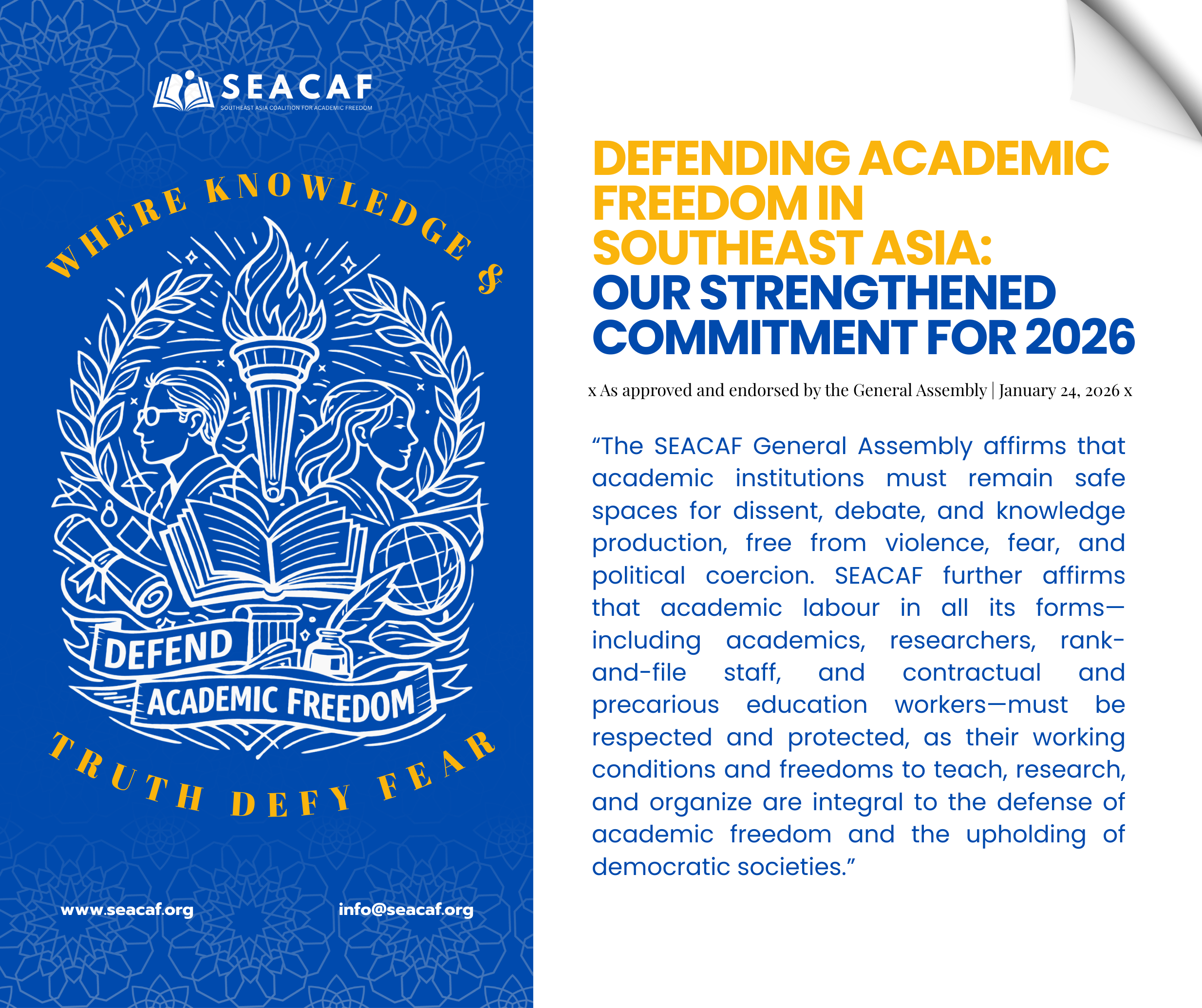
Silencing students and academics undermines not only academic freedom, but also broader struggles for justice, accountability, and democratic participation. We urge academic institutions, civil society, and the international community to remain vigilant and united in defending academic freedom as a foundation of a just, democratic, and inclusive Southeast Asia. SEACAF calls on governments across Southeast Asia to immediately end repression of academic communities, respect institutional autonomy, and uphold their obligations under international human rights law, including the rights to education and freedom of expression. Furthermore, the SEACAF General Assembly affirms that academic institutions must remain safe spaces for dissent, debate, and knowledge production, free from violence, fear, and political coercion. SEACAF further affirms that academic labour in all its forms—including academics, researchers, rank-and-file staff, and contractual and precarious education workers—must be respected and protected, as their working conditions and freedoms to teach, research, and organize are integral to the defense of academic freedom and the upholding of democratic societies. #
For more information, visit www.seacaf.org | To become a member, sign-up at: https://seacaf.org/member/